
👉 🇪🇸 ¿Prefieres español? Lee la reseña completa aquí →
Table of contents
Introduction
Proton Mail vs Gmail is one of the most searched comparisons for users trying to choose between privacy and convenience. In this guide, we break down their differences in security, features, usability, and overall approach to help you decide which one fits your needs in 2026.
What Is Proton Mail?
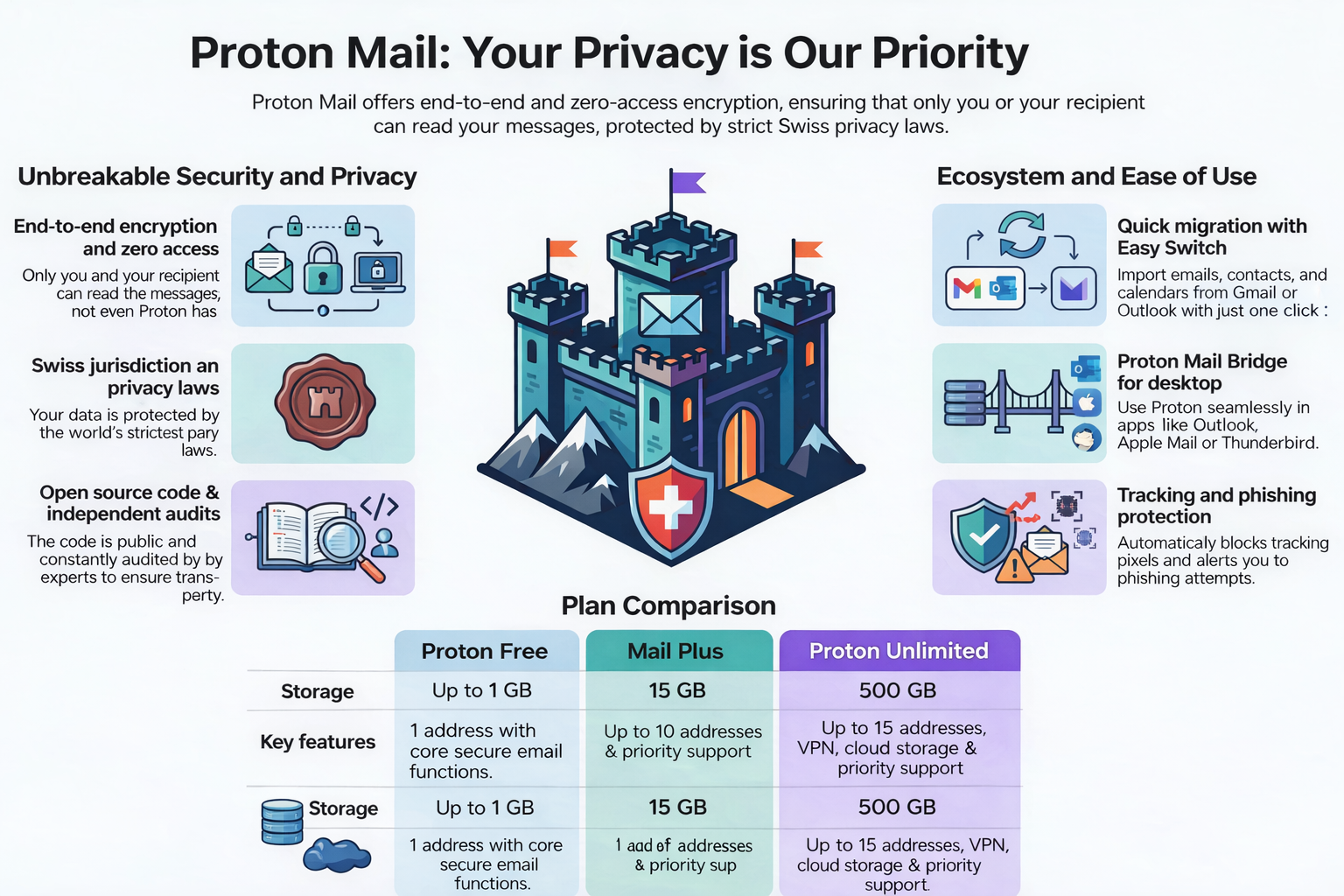
Proton Mail is a privacy-focused email service that fundamentally redefines how email works. While platforms like Gmail operate on data-driven business models, Proton is built around a system where user information is protected by design.
Founded by scientists and developed in Switzerland, Proton Mail uses end-to-end encryption combined with a zero-access architecture. This means emails are encrypted on the user’s device before being sent, and not even Proton can access their content.
Unlike traditional providers—where user data may be analyzed for advertising or profiling purposes—Proton eliminates this possibility at its core. Users retain full control over their information, without intermediaries.
Additionally, Proton Mail is not just an email service, but part of a broader privacy ecosystem that includes tools like Proton Drive, Proton VPN, Proton Pass, and Proton Calendar—all designed with the same principles of security and user privacy.
What Is Gmail?
Gmail is an email service developed by Google and one of the most widely used platforms worldwide. It stands out for its seamless integration with tools like Google Drive, Google Docs, Google Calendar, and the full Google Workspace ecosystem.
Its main advantage is ease of use and cross-device synchronization, allowing users to access their email from anywhere with a smooth and familiar experience.
However, unlike privacy-focused services such as Proton Mail, Gmail does not offer end-to-end encryption by default. Google may process certain data to improve its services, personalize the user experience, and provide smart features like automatic filtering or reply suggestions.
This makes Gmail a highly powerful option in terms of productivity and convenience, but with a different approach when it comes to privacy and data control.
Privacy and Security: Proton Mail vs Gmail
The main difference between Proton Mail and Gmail lies in how they handle user privacy and data security.
Proton Mail uses end-to-end encryption combined with a zero-access architecture. This means emails are encrypted before they leave the user’s device, and not even Proton can access their content. The decryption keys remain exclusively in the user’s possession, ensuring full privacy by design.
In addition, Proton operates under Swiss jurisdiction—one of the strictest in terms of privacy—and outside international surveillance alliances such as Five Eyes or Fourteen Eyes. It also includes advanced protections like tracking pixel blocking, IP address masking, and built-in anti-phishing systems.
On the other hand, Gmail relies on encryption in transit (TLS), which protects emails while they are being sent but does not provide end-to-end encryption by default. Google may process certain data to improve its services and deliver smart features, which results in a lower level of privacy in comparison.
In summary, while Gmail prioritizes functionality and ecosystem integration, Proton Mail is specifically designed to protect user privacy at every level.
Proton Mail vs Gmail: Quick Comparison
| Feature | Proton Mail | Gmail |
|---|---|---|
| Main focus | Privacy and security | Productivity and ecosystem |
| End-to-end encryption | Yes (by default between Proton users) | Not enabled by default |
| Access to email content | No (zero-access architecture) | May process data to improve services |
| Jurisdiction | Switzerland | United States |
| Tracking protection | Blocks tracking pixels and hides IP | Not specified as a core feature |
| Phishing protection | Yes (PhishGuard, Link Protection, Sentinel) | Yes (automatic security filters) |
| Integration with other tools | Proton ecosystem (Drive, VPN, Pass, Calendar) | Google ecosystem (Drive, Docs, Calendar, etc.) |
| Compatibility with email clients | Yes (Proton Mail Bridge) | Yes (IMAP/POP) |
| Ease of use | Medium (may require adaptation) | High (very intuitive) |
| Free plan | Yes | Yes |
| Advertising | No ads based on email content | May include personalized features based on data |
| Best for | Users who prioritize privacy | Users who prioritize convenience and productivity |
Pros and Cons: Proton Mail vs Gmail
Proton Mail Pros
- End-to-end encryption with zero-access architecture
- Not even Proton can access the content of your emails
- Based in Switzerland, with some of the strictest privacy laws in the world
- Advanced protection against phishing and malicious links
- Tracking pixel blocking and IP address masking
- Compatible with clients like Outlook or Thunderbird via Proton Mail Bridge
- Full ecosystem including tools like VPN, Drive, Pass, and Calendar
Proton Mail Cons
- Some advanced features require paid plans
- Proton Mail Bridge is limited to desktop use
- May require an adjustment period if you’re coming from traditional email services
- Less integration with third-party tools compared to other platforms
Gmail Pros
- Very intuitive and easy-to-use interface
- Full integration with the Google ecosystem (Drive, Docs, Calendar, etc.)
- High compatibility with third-party tools
- Smart features such as automatic filtering and reply suggestions
- Widely adopted and familiar to most users
Gmail Cons
- Does not offer end-to-end encryption by default
- Less privacy-focused compared to specialized services
- May process data to improve its services
- Reliance on the Google ecosystem to unlock its full potential
Who Is Proton Mail vs Gmail Best For?
In this Proton Mail vs Gmail comparison, it’s clear that the choice between the two largely depends on your priorities: privacy or convenience.
Proton Mail Is Best For:
- Users who prioritize privacy and data security
- Professionals handling sensitive or confidential information
- People who want to avoid tracking and data collection
- Users seeking a more independent digital environment outside big tech ecosystems
- Those who value encryption and full control over their information
Gmail Is Best For:
- Users who value ease of use and an intuitive experience
- People already using the Google ecosystem (Drive, Docs, Calendar, etc.)
- Users who prioritize productivity and seamless tool integration
- Those who need compatibility with multiple external services
- People who value automated features and smart assistants
Conclusion: Proton Mail or Gmail?
Proton Mail and Gmail represent two fundamentally different approaches to email. While Gmail stands out for its integration, ease of use, and powerful ecosystem, Proton Mail focuses on a model built around privacy and user control.
In a digital environment where personal data has become a valuable asset, more users are looking for alternatives that allow them to regain control over their information. In this context, Proton Mail offers a strong value proposition based on encryption, transparency, and privacy by design.
👉 If you’re ready to switch to a more private and secure email experience, you can check out the full Proton Mail guide here.
If you’re still deciding between Proton Mail vs Gmail, the choice ultimately comes down to whether you prioritize privacy or seamless integration with other tools.
The final decision depends on your priorities: convenience and ecosystem, or privacy and control.
You can also check out our Proton VPN guide if you want to further enhance your online privacy protection.
If, in addition to protecting your privacy, you’re thinking about creating a website or launching an online project, you may consider hosting services like SiteGround, known for their strong performance, ease of use, and WordPress-optimized support.
Frequently Asked Questions: Proton Mail vs Gmail
Is Proton Mail more secure than Gmail?
Proton Mail takes a privacy-first approach, using end-to-end encryption and a zero-access architecture, meaning not even the service itself can access the content of your emails. Gmail, on the other hand, uses encryption in transit and advanced security measures, but does not provide end-to-end encryption by default.
Can Gmail read my emails?
Gmail does not provide end-to-end encryption by default, which means it may process certain data to improve its services, such as spam filtering or smart features. However, it does include multiple layers of security to help protect user accounts.
Is it worth switching from Gmail to Proton Mail?
It depends on your priorities. If you’re looking for greater privacy and control over your data, Proton Mail is a strong alternative. If, on the other hand, you prioritize seamless integration with tools and ease of use, Gmail may be the more convenient option.
Is Proton Mail free?
Yes, Proton Mail offers a free plan with basic features. It also provides paid plans that expand storage and include additional functionalities such as access to Proton Mail Bridge.
Which is better for professional use: Proton Mail or Gmail?
Gmail stands out for its integration with productivity tools and its widespread use in professional environments. Proton Mail, on the other hand, is better suited for professionals who handle sensitive information and prioritize privacy and security in their communications.
Within the Proton Mail vs Gmail comparison, Proton excels in privacy, while Gmail leads in ecosystem and integration.
This article contains affiliate links. We may earn a commission at no additional cost to you.
Sources: