
🇪🇸 Prefer Spanish? Read the full review here →
Proton Mail is one of the most secure email services on the market, designed to protect user privacy through end-to-end encryption.
⭐ Rating: 4.7/5
✔ Free plan available
✔ High privacy (Switzerland)
✔ End-to-end encryption
Proton Mail Guide: Table of Contents
Introduction
In today’s digital ecosystem, we often assume that accessing powerful tools comes at no monetary cost. However, the most popular email providers—such as Gmail, Outlook, or Yahoo—operate under what is known as “surveillance capitalism”: they analyze the content of your messages and attachments to build detailed profiles of your habits, interests, and preferences. This constant tracking turns your private information into a product for advertisers and data brokers, fueling the creation of “shadow profiles” you never authorized.
In this context, Proton emerges as a privacy-first alternative. Founded by scientists, it offers more than just a tool—it represents a shift in paradigm: an environment where technology protects the user instead of exploiting them, restoring control over their digital identity
Proton Mail Overview
Unlike many traditional email services, Proton Mail prioritizes user privacy through end-to-end encryption and a zero-access architecture. This means that not even the provider itself can access the content of your emails.
Additionally, being based in Switzerland, it benefits from one of the strictest privacy laws in the world. Proton Mail positions itself as a secure alternative to services that analyze user data for commercial purposes, offering an experience focused on protecting personal information.
Quick Summary
Best for: privacy, security, and control over personal data
- Type: encrypted email service focused on privacy
- Price: from €0/month (depending on the plan)
- Location: Switzerland (outside surveillance alliances)
- Security: end-to-end encryption + zero-access architecture
- Compatibility: available on web, apps, and desktop clients via Bridge
What is Proton Mail?
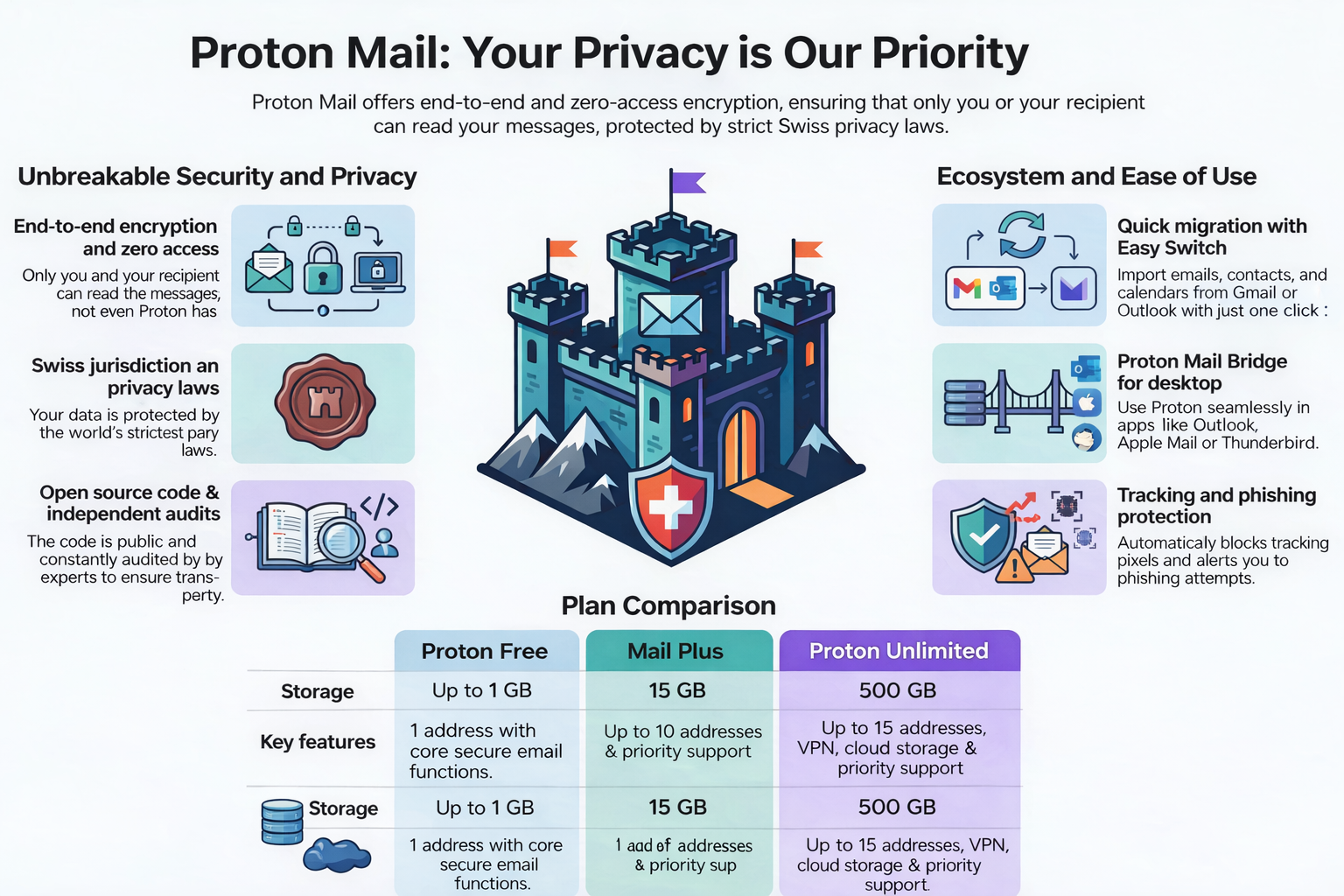
Proton Mail is a secure email service designed to protect user privacy through end-to-end encryption and a zero-access architecture. This means that messages are encrypted before leaving the user’s device, and only the recipient can read them—without even Proton being able to access their content.
Developed in Switzerland, Proton Mail benefits from some of the strictest privacy laws in the world, offering an alternative to traditional services that analyze user data for commercial purposes.
Zero-Access Encryption
Unlike the standard encryption used by other services—where the company retains “master keys” to decrypt your messages if required by an advertising algorithm or a foreign authority—Proton uses a zero-access architecture.
In this model, content is encrypted on your device before it reaches the servers. Since Proton does not hold the decryption keys, it is mathematically impossible for them to access your inbox or share your data with third parties. This eliminates the risk of any technical or legal breach by the provider.
“Proton Mail’s end-to-end encryption and zero-access encryption ensure that only you can read your emails. Not even Proton can view the content.”
Proton Mail Bridge
Migrating to a privacy-focused solution often involves friction when changing tools. Proton addresses this with Proton Mail Bridge, a desktop application available to users with paid plans.
Bridge integrates your Proton Mail account with popular email clients such as Microsoft Outlook, Apple Mail, or Mozilla Thunderbird via IMAP/SMTP, adding a layer of end-to-end encryption that these platforms do not natively provide. Your passwords and PGP keys never leave your device, allowing you to maintain your usual workflow and access your emails offline without compromising security.
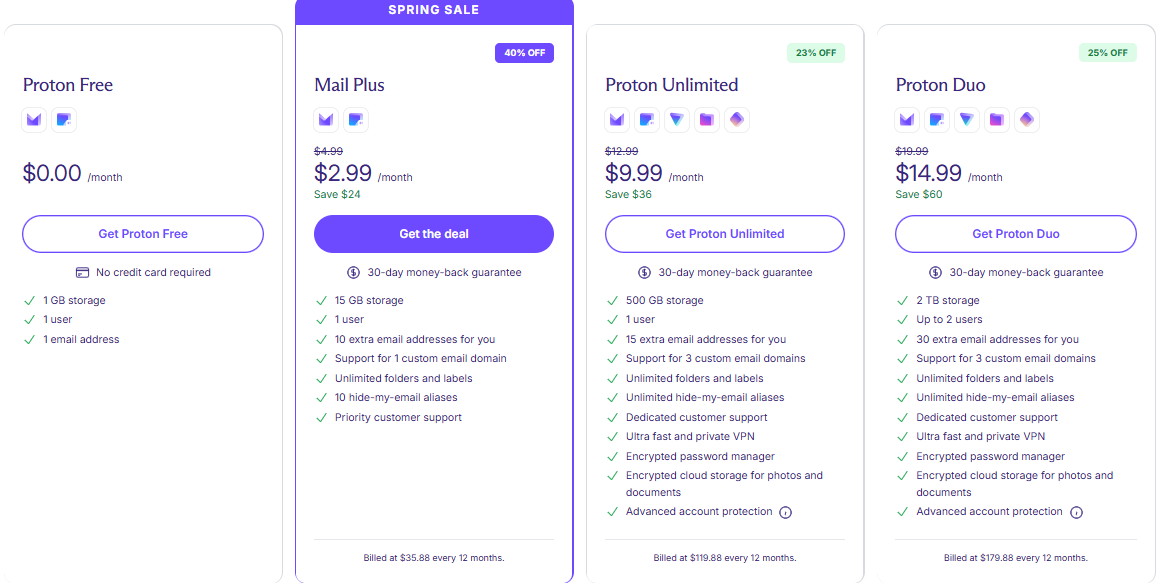
Pricing and Plans
| Plan | Type | Key features | Best for |
|---|---|---|---|
| Free | Free | Encrypted email, zero-access architecture, basic features | Users looking for privacy at no cost |
| Mail Plus | Paid | More storage and advanced email features | Individual users with frequent usage |
| Proton Unlimited | Paid | Includes Mail, VPN, Drive, Pass and Calendar | Users who want the full privacy ecosystem |
| Business | Paid | Team management tools and secure collaboration | Companies and organizations |
Prices may vary depending on promotions and subscription duration. It is recommended to check the official Proton Mail website for the latest offers.
Swiss infrastructure and privacy
Proton’s protection model combines strong legal safeguards with robust physical security. Headquartered in Geneva, Switzerland, the company operates under Swiss privacy laws—among the strictest in the world—and remains outside international surveillance alliances such as the Five Eyes and Fourteen Eyes. Any data request must be approved by Swiss authorities and is only processed in accordance with Swiss legal requirements.
In addition, Proton owns and operates its own hardware infrastructure. Its servers are hosted in high-security data centers with biometric access controls, and all hard drives are encrypted with multiple layers of protection.
Security and threat protection
Proton integrates practical tools designed to protect you in everyday use:
- Easy Switch allows you to import emails, contacts, and calendars from other providers, encrypting your data throughout the entire process.
- PhishGuard blocks phishing and impersonation attempts.
- Link Protection scans URLs before you open them to prevent access to malicious websites.
- Proton Sentinel combines artificial intelligence with human review to detect and stop sophisticated attacks.
The system also blocks tracking pixels and hides your IP address, preventing third parties from monitoring your activity.
Proton Mail review: pros and cons
Pros
- Complete ecosystem including VPN, Drive, Pass, and Calendar
- End-to-end encryption with a zero-access architecture
- Not even Proton can access the content of your emails
- Based in Switzerland, with some of the world’s strictest privacy laws
- Advanced protection against phishing and malicious links
- Blocks tracking pixels and hides your IP address
- Compatible with email clients like Outlook and Thunderbird via Proton Mail Bridge
❌ Cons
- Some advanced features require a paid plan
- Proton Mail Bridge is limited to desktop use
- May require an adjustment period if you’re coming from traditional email services
- Less integration with third-party tools compared to other providers
Proton ecosystem
Proton has evolved into a privacy-focused productivity suite that goes beyond secure email. It includes Proton Drive for encrypted cloud storage, Proton VPN for private browsing, Proton Pass as a password manager, and Proton Calendar for personal organization.
The ecosystem also continues to expand with newer tools such as Proton Meet for video calls, Proton Wallet for Bitcoin management, and Proton Scribe, a privacy-first writing assistant.
What does “zero-access” mean in Proton Mail?
It means that the content of your emails is encrypted on your device before being sent. Proton does not have access to the decryption keys, which means it cannot read or access the content of your messages.
What is Proton Mail Bridge and what is it used for?
It is an application that allows you to use Proton Mail with traditional desktop email clients while adding an additional layer of end-to-end encryption.
How does Proton Mail protect against attacks and fraud?
It includes tools like PhishGuard to block impersonation attempts, Link Protection to analyze links, and Proton Sentinel to detect advanced attacks.
Does Proton Mail prevent tracking of my activity?
Yes. It automatically blocks tracking pixels and hides your IP address to prevent tracking by third parties.
Can I migrate my emails from Gmail or other services?
Yes. With the Easy Switch tool, you can import emails, contacts, and calendars from other providers in an encrypted way.
Can I create a free email account?
Yes, it always offers a free email plan for people who need it. Unlike other providers, you can create a free email account with Proton Mail without sacrificing privacy. To create a free Proton Mail email account, you can click Get Proton for free. Proton Mail’s free plan includes 500 MB of Mail storage.
Is Proton Mail worth it in 2026?
Proton Mail is one of the best options for users who prioritize privacy and security over the convenience of traditional email services.
It is especially recommended for:
- Privacy-conscious users
- Professionals handling sensitive information
- People who want to avoid tracking and targeted advertising
However, it may not be the best choice for those who rely heavily on the Google ecosystem or need full integration with third-party tools.
Conclusion
Proton’s approach is built on a clear principle: privacy as the foundation of the internet. In an environment where personal data has become a commercial asset, using tools that prioritize user protection allows you to regain control over your personal information.
The final decision is not just technological, but strategic: choosing between being the product or being the owner of your digital identity.
If, in addition to securing your communication, you’re considering creating a website or launching an online project, you may also want to explore hosting services like SiteGround, which are optimized for WordPress and users seeking strong performance and reliable support.
👉 If you want to protect your browsing, check out the complete Proton VPN guide
This article contains affiliate links. We may earn a commission at no additional cost to you.
Sources: https://proton.me/mail